
Jack Darcy, Drones and a Trip to Antarctica
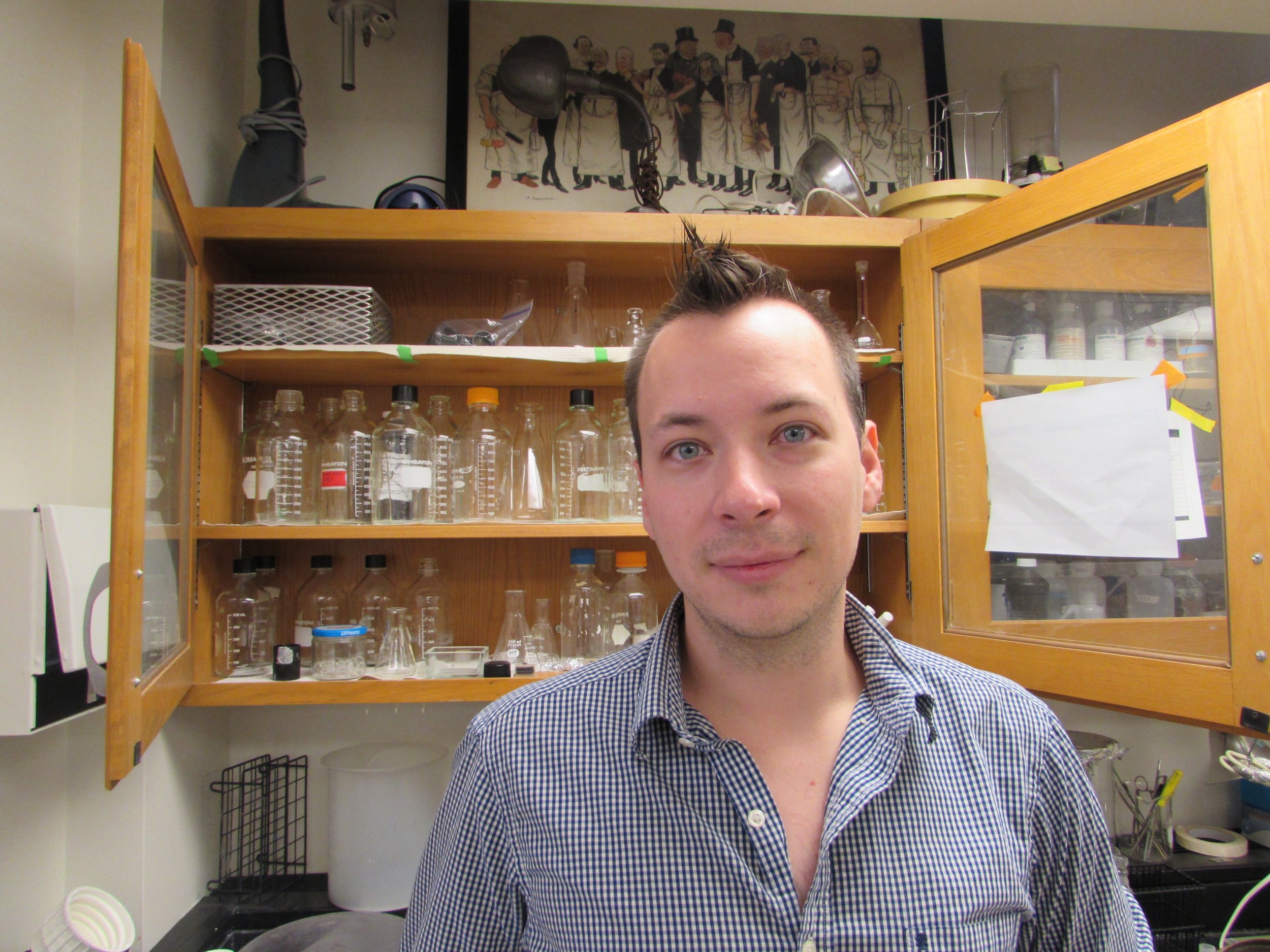
Jack Darcy, a doctoral candidate at CU Boulder is preparing for his first Antarctic expedition to study cryoconite holes in the dry valleys of the coldest place on earth.
Jack Darcy is a doctoral candidate at CU Boulder specializing in Computational Biology, a burgeoning field of study that combines statistics and life science to answer some of biology's most pressing questions. Jack is currently preparing for an expedition to Antarctica, where he will study cryoconite holes, or ice holes in the glaciers of Antarctica's dry valleys. In this interview, Jack voices his excitement and his anxieties of what this voyage to the bottom of the world will bring, and what it means for him as an early career scientist.
From Climate Change to Plague, The American Pika Faces Many Environmental Obstacles
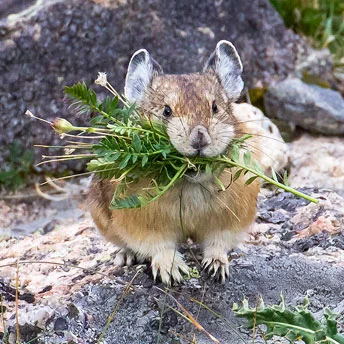
An American Pika builds its nest - www.nps.gov
Pikas are disappearing. This is bad news not only because they’re fuzzy and adorable, but because they’re also seen as a canary in the coal mine for global climate change. While many biologists are taking notice of this fading species, government agencies are slower to recognize the change.
The U.S. Fish and Wildlife Service recently rejected a petition to review the American pika’s status as a potentially endangered animal. In order to qualify as endangered, a species must experience a 50 to 70 percent decline, according to the Endangered Species Act.
Chris Ray, a biologist with INSTAAR, the Institute for Alpine and Arctic Research in Boulder, Colorado, emphasizes the importance of pikas not necessarily as an integral part of the high alpine ecosystem, but as a signal for changing climate.
“They’re not really a significant source of food for any predators, and they don’t really provide much for the environment,” said Ray, “but when the permafrost disappears, so do the pikas. And that means no more water.”
This is particularly bad news for places like Utah and California, both of which depend heavily on high-mountain permafrost and snow melt for municipal water. Similarly, Boulder scientists like Ray are keeping a close eye on Rocky Mountain pika populations as an indication of the future of Boulder’s water supply.
When pikas disappear, that’s a strong indication that permafrost too is about to fade away.
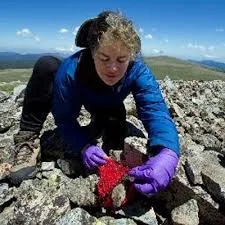
Chris Ray of INSTAAR nets a pika
"Pikas survival in the Rocky Mountains is a good indication as to their survival elsewhere" said Erika Garouette, a mammologist and pika specialist at the Denver Zoo.
Because of the specificity of their preferred temperatures, pika habitats are few and far between, leading to a 30-50% decline, according to the Front Range Pika Project, in some areas that falls just short of what is required in order to be considered endangered.
Pikas, a native Colorado species, are the smallest members of the rabbit family, and live in the talus slopes, or rocky patches of rock in high alpine environments such as the Rocky Mountains. These alpine critters evolved from Siberian ancestors that crossed the land bridge that once connected Alaska and Asia, and are dependent on cold and rocky slopes to survive. Pikas can die when exposed to temperatures as mild as 78 degrees, according to a study by INSTAAR, a problem exacerbated by a warming climate and retreating permafrost. Once mountains begin to warm, pikas can only retreat so far upslope, causing many populations to decline or disappear altogether.
Pikas need a dense blanket of snow to provide insulation for harsh mountain winters. Without dependable snow cover, pikas can’t weather the extreme cold of high alpine winters, nor can they tolerate the increasingly warm summers. This August, the U.S. Geological Survey conducted a study of pikas, and found that their population has dramatically decreased in areas of Utah and California, a decline that the USGS links to a warming climate. The U.S. Fish and Wildlife Service did not take the USGS’s most recent findings into account when considering the pika’s status
.
Luckily, Colorado populations are relatively robust. An extensive survey in 2008 by Colorado Parks and Wildlife examined 62 known pika habitats, and found that 90 percent of these habitats still supported healthy pika populations. While Colorado is not exempt from climate change, it does boast altitudes above 14,000 ft., making it an ideal place for cold-seeking pikas. Since the 2008 survey, Colorado Parks and Wildlife has documented upwards of 900 occupied habitats boasting healthy pika populations.
As for the future of the pika, Ray is relieved that they didn’t receive classification as an endangered species.
“It could be potentially disastrous to have them classified as endangered under the Endangered Species Act, because I don’t feel the ESA has the legislative teeth to help us protect the American pika by stopping global warming. I just don’t think that’s a viable tool,” Ray said.
That’s not to undermine the precariousness of the pikas situation, which is indeed dire. Populations in Utah, California and Oregon have decreased in numbers from 30 to 50 percent, according to the most recent USGS study. As mountain tops warm and talus slopes become too warm to support pikas, they have no retreat. Besides bringing attention to the issue, the Endangered Species Act has no real way to address the root of the issue—namely, global climate change.
Though many people are upset that pikas won’t be appearing on the Endangered Species List, a more holistic approach to pika conservation is required, and this review of the fuzzy critter’s status could serve as a wake up call to those unaware of the pika’s plight.
Video Critique
The lede for the video was effective, and starts en medias res with the interviewer asking the fisherman the question, “So is it about more than losing your paycheck?”. This immediately propels the viewer into the conflict by establishing tension between the fishermen, their previous income and new legislation. The fisherman responds, “It's just strange, fencing of a place and you’re never going back to it, you know.”, which heightens the tension by emphasizing how bizarre the idea is for him.
The video then cuts to b-roll of colorful coral, which provides a juxtaposition to the relative squalor of the fishing boats. A voice-over then explains that Obama had established the first marine national monument, and putting the voice-over on the b-roll of coral footage creates tension by portraying it in a positive light, as compared to our initial impression from the fisherman.
The video uses establishing shots to set the scene on the ocean, then cuts to a fishing boat, and finally to an industrial fishing factory scene where we see people cleaning fish and crabs. This series of shots not only establishes the setting, but underlines the tension between the desire for pristine oceans and corals and the need for a competitive fishing industry. The camera shows a sequence of shots of colorful coral as a voiceover explains the importance of the unique and old species present in the marine environment.
Then we see an interview of a Democratic senator from Connecticut, who emphasizes the importance of these reefs and provides a counterpoint to the fisherman’s side of the story. VICE then uses an animated illustration to show how large this preserved area is, comparing it visually to the size of Rhode Island.
VICE interviews a fisherman who presents his side of the argument. We see his milieu, which underlines the blue-collar worker vs. big government tension built into the narrative. The cuts are all quick, which moves the narrative forward effectively while still establishing enough about the scene and characters to make those narrative elements compelling.
Next, we see stock footage of the White House which emphasizes the executive branch’s role in creating these marine preserves. This creates a visual and emotional distance between the fisherman and the president, again underscoring the tension. We return to the senator, who is asked to respond to the fishermen’s criticism that their voices were not heard. This gives the video credibility for trying to portray all perspectives equally, and allowing their sources to answer criticism.
B-roll of fisherman cleaning, sorting, and moving crabs continues in the background, providing a contrast to the discussion abotu “pristine reefs” that we hear from the voice over. This again heightens tension between industry interest and conservation efforts on the reef, and gives the video a nuanced and compelling angle on the issue.
The aesthetics of the video were very effective at creating tension, and underlining a compelling narrative of beautiful corals and unhappy fisherman. Video was a great way to tell this story because we get to see beautiful shots of corals as well as see interviews of politicians, fishermen, and other involved parties.
The online presentation was crisp and clean, as VICE prefers a minimal style that prioritizes visuals. There’s just a simple video player with one-line description.
The Force that Works or: How I Learned to Stop Worrying and Love the EDK

This past weekend, I spent about 14 hours strapped to an 11,000 ft. granite peak in Colorado’s Front Range. Multi-pitch climbing, or large-scale climbing ventures that require several climbs linked together, necessitate lots of ropes, heavy gear, and knots. Most of the time when I’m climbing, I’m focused on choosing and executing the correct not, and am not typically concerned with how the know works, but, after hours anchored into the same rock face, the mind begins to wander.
After the death of a Washington climber in late September due to a rappel knot failure, I decided to do some research into the knots that I trusted with my life this past weekend. After an 11 pitch climb, our descent required about 7 rappels and would have required more had my partners and I not tied our ropes together. When you have to depend wholeheartedly on two ropes and one knot, it helps to know the force at work behind them.
Rock and Ice Magazine attributed the Washington climber’s death to the failure of a flat figure 8 (see picture), a knot that should NOT be used to join rappel ropes. The extra bend in the flat figure 8 can actually cause the knot to walk and collapse in on itself, and the smaller the diameter of rope, the more likely it is to collapse in on itself. The flat figure 8 is frequently referred to as a variation of the European Death Knot, a relationship that I contest due to the vast difference between the ability of each knot to tolerate certain loads. The direction of force on the flat figure 8 actually pulls the two lengths of ropes in a different direction, which can cause the knot to fail. Recent tests by Black Diamond reveal that the flat figure 8 will collapse under significantly lighter loads than its paradoxically named counterpart - the European Death Knot.
The European Death Knot, or flat overhand bend, is commonly referred to as the EDK. Similar to the flat figure 8, it is also an asymmetrical knot used to join rappel ropes. The asymmetry of the knot gives it a flat underside that makes the rope easier to pull down rocky slopes that are prone to snagging. Where the flat figure 8 is prone to failing at loads as small as 750 lbs, the EDK when properly tied and dressed, will hold 1,400 lbs. The direction of force on the EDK pulls the two lengths of rope in the same direction, again making it a safer knot for joining two rappel ropes. When properly pre-tensioned and tied, failure is typically attributed to a physical failure of the rope rather than the knot.

Photo: Rock and Ice Magazine
Though like many asymmetric bends, it has the ability to walk to the end of the rope, this is easily prevented by tying a simple backup stopper knot such as an additional overhand that will add to the symmetry and decrease the chances of your knot walking off the end of your rope and failing. Flat knots, such as the EDK and the flat figure 8, are extremely sensitive to mis-tying, which gives the EDK another distinct advantage in that it is very simple to tie. That being said, there is no margin for error thousands of feet above the ground, so practice, diligence and leaving a tail is key for correctly tying any knot.
Salt Lake County Sheriff's Office Search and Rescue has performed weight tests on different versions of nearly every climbing knot - wet, cold, non-redundant and poorly tied to test their strengths and weaknesses. Four accidents and three fatalities have been attributed to EDK failure: Zion in 2002, Grand Teton National Park in 1997, Big Cottonwood Canyon in 1995 and Seneca Rock in 1994. Moyer, the source for my data, contests that these mishaps were most likely flat figure 8 failures mislabeled as the EDK. Moyer promotes the use of the EDK, and contest that the few deaths that have previously been attributed to the EDK were, in fact, the flat figure 8. Their test results of the EDK can be found here.
Delving into spreadsheets of weight tests of various climbing knots probably isn’t most people's idea of a good time, but the forces behind these commonly used (and confused) knots are fascinating and comforting. The only remaining issue? Lets rename the EDK.
Audio Scavenger Hunt
We had 43 clips, of which 13 sounds made the cut. Most were chosen for clarity of sound, and ease of editing. Sounds that were most easily understood made the cut, while others that were less easy to interpret were not. It took me about 40 minutes to edit, the only problem being that adobe crashed on me twice, because it takes up a lot of memory..
Linking Large-scale Weather Events and Climate Change

Between August 11th and 14th, over 25 inches of rain fell on southeastern Louisiana, killing 6 people and leaving 20,000 more stranded and without homes.
The Lower Mississippi River Forecast called it a one in 1,000 years rain, resulting from a slow moving pressure cell. It was the worst disaster since Hurricane Sandy, according to CNN. one in 1,000 years deluge of rain flooded large parts of Louisiana, as a result of a slow-moving pressure cell. It was the worst disaster since Hurricane Sandy, according to CNN.
In fact, this year has seen a surge in extreme weather events all around the world according to NOAA. According to James White, Director of the Institute of Arctic and Alpine Research at the University of Colorado, they all have one thing in common: climate change.
"Every storm out there has the fingerprint of climate change on it,” said White. “There’s just more energy out there” , this energy augments pre-existing storm cells, like adding a tailwind to an already accelerating car.
White explained that scientists have observed an increase in large rainfall events, especially those that rank in the top 20% of precipitation. As the climate continues to change and the oceans warm, we’re likely to see even more big rain events like the one in Louisiana, he predicted, and they are likely to become even more severe.
It is impossible for scientists to attribute a single extreme weather event to one specific cause like climate change.It can also be difficult to suss out all of the complex convergence of events that contribute to specific flood events.
Was this major flood enhanced by oceanic and atmospheric temperatures made warmer by climate change?
White and other scientists say that this is increasingly the case.
As the climate warms, more water evaporates from the oceans into the atmosphere. At the same time, warmer air is able to carry even more water vapor: For every 1 degree C increase, the atmosphere can carry 7 percent more moisture.
As the Earth has warmed some 4-7 degrees celsius in the past 5,000 years, thanks to increases in heat-trapping carbon dioxide, more moisture has been available in the atmosphere to fuel storms. The result: a greater potential for intense precipitation like the 2-day downpour experienced in Baton Rouge last month.
“We have observed an increase in the top twenty percent of rainfalls,” said White, alluding to the increase in large rain events experienced in the last ten years, and it seems there’s more to come.
“There’s going to be more big rains,” said White. “It’s the inevitable result of a warmer planet”.
Scientists project that heavy rainfall events are likely to increase worldwide, but particularly across the Midwest and Northeast United States.

These large rain events can be expensive. Though the cost of these events is driven by multiple factors (such as an increase in property value and amount of property owned in affected areas), we are spending increasing amounts of money to mitigate the damage caused by increased precipitation. In Louisiana alone, there have been more than 40 weather events resulting in a billion or more dollars worth of damage in the past 30 years.
In 2012 alone, there 32 such events in the U.S., making it the 2nd costliest year on record, according to the EPA. These more frequent events are only part of the equation, the US has also developed a habit of implementing costly infrastructure in the path of the storm. Projects such as bridges, levees, and dams that have been known to fail under extreme stress, adding to the economic impact of such events.
Thanks to the work of World Weather Attribution, there are new models and methodologies for analyzing and predicting how much of a role climate change may play in such events. Though there were many complicating factors in WWA’s study, such as weather over the Gulf Coast, the WWA believes that the Louisiana floods are indeed consistent with the types of events they would expect to occur in a warmer climate.
These types of large scale rain events are likely to continue to occur with increasing frequency, White said. And he pointed out that even with increased awareness of climate change, these large patterns take centuries, if not thousands of years to reverse.
White's advice?
“Until one generation is willing to forego short term gains for the long term benefit of its children, we won’t be able to address climate change”
Sourdough Science Part I - The Starter

Deep in the recesses of my kitchen cabinets, there’s a glass jar that contains flour, water and millions and millions of tiny organisms. It emits a subtle vinegary flavor as gaseous bubbles slowly rise to the top and burst across the pale beige surface.
Meet my sourdough starter.
This recipe for bread is ancient, dating as far back as 5,000 years to create a dough that is pleasantly tangy and sweet. Humans have been mixing flours and water while waiting for it to ferment for thousands of years, though the science and microbiology at work were not understood until relatively recently. In 1856, French scientist Louis Pasteur discovered that microbes, or microscopic living organisms, were behind the fermentation process.
Here’s where things get interesting. Sourdough starter relies on ambient microbes, called wild yeast for the fermentation process. Think of it as starting a zoo with wild animals who happen to wander into your enclosure. These bacteria are sensitive to factors such as temperature and humidity, and while the species will not vary much from place to place, the specific ratio of bacteria will vary depending on climate. Because of this, the sourdough starter from different geographic areas will taste slightly differently, reflecting the specific strains present in your particular area. Perhaps you’ve heard of the famous San Francisco sourdough, after which the bacteria L. sanfranciscensis is named.
Wild yeast, or saccharomyces exiguus, is a different strain of yeast than what you find in pre-packaged yeast, which is a monoculture of S. cerevisiae. The yeast doesn’t really affect the taste of the sourdough, but wild yeast is much heartier than commercial yeast, and better suited to the highly acidic environment of sourdough starter.
L. sanfranciscensis is not the only actor present in sourdough starter - most will also contain a combination of wild yeasts and lactic acid bacteria such as Lactobacillus brevis, L. reuteri, L. johnsonii, orL. Acidophilus, and L. plantarum. These little guys feed on amylase, an enzyme naturally present in flour, and the yeasts act as a leavening agent while producing alcohol and carbon dioxide as a by-product. Hence, the bubbles. The lactobacillus, similar to the microorganisms found in cheese and yogurt, also feed on sugars present in your starter and produce two different kinds of acid as a by product.
These little guys churn out the lactic acid that gives sourdough its lovely, rich mellow flavor, and acetic acid, which is responsible for the tangier element of sourdough’s flavor profile. This acetic environment protects your starter from picking up harmful bacteria that might make you sick. Thanks, guys!
As the sugars in sourdough starter are converted to acid, the pH drops down to around 3.8, similar to that of mayonnaise, cherries or cider. These little guys lived in pretty cramped corners in my small jar and are forced to survive through a symbiotic relationship. Resources are scarce, and yeasts such as C. milleri might rely on fructose, glucose, or galactose as food sources, leaving L. sanfranciscensis bacteria to indulge on maltose as their source of food. The ecological niche that is my kitchen cabinet requires cooperation and coexistence and does not allow for much competition between microbes.
So, how’s your starter faring? The gasses produced by the yeast will rise to the top, and this is how you know your cultures are healthy and thriving.

A Day at the Farmers' Market
At the Boulder Farmer's Market, the early bird gets the worm...or...er...the burrito. On a mission to find provisions for a day hike, I arrived early to the Boulder County Farmer's Market. Some vendors were still setting up their tents and arranging their wares in colorful and delicious displays, touting everything from Palisade Peaches, kombucha, pupusas, tomatoes, and what appeared to be fist-sized grayish logs labeled as "raw-vegan bean brownies".
No thanks.
After scooping up a couple particularly fresh, yet firm, peaches I wander over to a corral of food trucks to find heartier sustenance. I'm just early enough to catch an elderly woman tenderly rubbing fresh lumps of corn masa into tortillas. The pale yellow circles were baked into a pleasant beige as the morning sun too transitioned from its shade of gold to a cheerful flaxen hue.
I grab a veggie burrito, thankful for the warm tin-foil lending its structural integrity to the home-made tortilla. It was now 8:30, and the market was bustling with Boulderites of all ages, riding bikes, pushing strollers, and roller-blading towards the rows of produce-laden tents.
Reusable shopping bags bursting with fresh fruits, veggies, and baked goods, people mingled in the street and in the nearby Central Park, enjoying their purchases and people-watching.
I stood on the corner of Canyon and Arapahoe and watched people fork over cash for organic tomatoes and carrots, the juice of my own Palisade Peach running down my chin as I try to covertly snap a photo.
This, is fall in Boulder.

The Science that Inspired "Stranger Things"

Netflix’s retro-inspired sci-fi series, “Stranger Things” tells the story of worlds in collision, and a group of sinister, runaway government scientists who have unintentionally bridged the gap between two parallel universes. While we can be pretty sure our government has not, in fact, opened the portal between our world part of the multiverse, there is compelling scientific inspiration behind this plot premise. So compelling, that the U. S. Department of Energy released a statement explaining that they are not an evil, rogue organization researching monsters and parallel universes.
While it's unlikely that a gooey gray-green “upside-down” world of “Stranger Things” hovers just beneath our own, the idea of parallel or multiple universes is one that has been explored by theoretical physicists for decades. Parallel, though slightly varied worlds have been a theme in theoretical physics, and while there is no evidence that supports their existence, many scientists have attempted to use these ideas to explain quantum mechanics, and natural phenomena like gravity.
“Stranger Things” seems to be taking cues from physicist Hugh Everett’s “many worlds” theory. This theory posits that whenever someone “measures”, or observes something in the universe, such as ordering a cheese pizza instead of pepperoni, two separate realities spring from that moment. This is further evidenced by the fact that the rag tag bunch of boys’ science teacher, Mr. Clarke, references Everett’s theory.
Unlike in “Stranger Things” these parallel universes are entirely separate, and cannot interact. So, no light-flickering monsters and whispers coming out of walls.
In a paper published in 2014, physicist Bill Poirier proposed a different version of this theory, called many interacting worlds theory. According to Poirier, these worlds can talk and interact with each other. Unlike Hawkins Indiana and it’s sinister twin “upside-down” world, our neighboring universes would be pretty similar to our own, and we’d be unable to travel between them. According to Poirier, universes would be layered one on another, with more similar worlds closer together, and more variant universes being farther away. On the off chance you were able to travel to a neighboring universe, it would be pretty similar to our world, probably no demogorgans or weird, fleshy snow.
Unfortunately for fans of “Stranger Things” there is no evidence of any such parallel world, though theoretical physicists are still positing potential theories involving multiple, or parallel universes.
Fortunately, this lack of scientific evidence likely won’t derail the creation of a season 2.