
Drink Local, Save the World

When it comes to hops, there's no place like home.
In Boulder, there’s no shortage of local breweries. It seems every street corner is bedecked with gleaming silos that waft the distinct perfume of fermenting hops. With such a wealth of options from Sanitas, Boulder Beer, Upslope, Mountain Sun and more, there's plenty of good reasons to drink local.
The most compelling reason, besides local pride, could be the environment.
Brewing is not a carbon neutral operation. While the emissions created in the brewing process pale in comparison with that of fossil fuel activity, it is enough cause for beer locavores to clink glasses in celebration.
An in-depth analysis by New Belgium Brewing Company of Fort Collins, Colorado in collaboration with the Climate Conservancy, a greenhouse gas impact auditing firm from California, reveals what parts of the brewing, distribution and retail process emit the most greenhouse gasses (GHG's). This cradle-to-grave report doesn't skimp on details, even factoring in GHG's emitted by employee commuting (12.7 grams of CO2 per 6-pack, or approximately .4 percent of GHG's emitted in the production of one six-pack of beer).
While it is predictable that the process that produces a carbonated beverage would intrinsically produce carbon emissions as a byproduct, the bulk of GHG emissions don't originate from the brewing process itself, but rather from retail and distribution. In fact, the carbon used in the brewing process only accounts for 2.3 percent of total GHG emissions involved in the process.
The single largest line-item accounted for in the study was refrigeration at retail, which produces 829.8 grams CO2, or 26 percent of the carbon emitted in the entire journey from hop to home. While refrigeration is the most carbon-intensive step in the process, another 2.1 percent of the total carbon emissions produced are emitted by other various retail activities such as lighting in store displays.
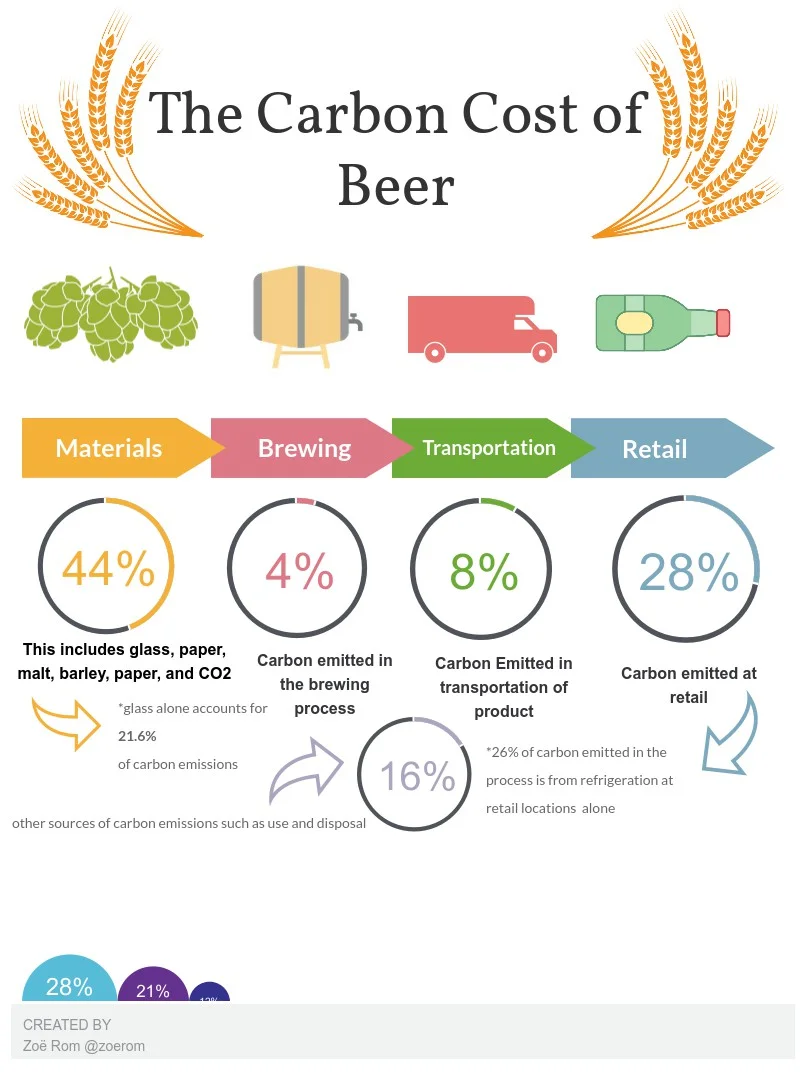
The second largest source of carbon emissions is glass. Though many craft brew aficionados prefer long necks to their aluminum counterparts, glass production is carbon-intensive, accounting for 690 g CO2, or 21.6 percent of the carbon emitted per six pack. Glass production requires an immense amount of heat which in turn emits a large amount of carbon. Even using 10 percent recycled materials, as per industry standard, in the production of glass beer bottles accounts for a large portion of the carbon emissions required to make beer.
Avery Brewing Company, based in Boulder, is also interested in reducing their carbon footprint even as they expand in the craft brew market. Avery has installed a carbon reactor system installed that captures the C02 produced during fermentation. A Carbon Cycle reactor splits sodium nitrate, a common salt, into nitric acid and sodium hydroxide. The sodium hydroxide is then used to capture and convert CO2 into soda ash, which is used by area glass companies to manufacture beer bottles. This not only prevents carbon from being released into the atmosphere, but it limits carbon required in glass manufacture, making the process carbon negative. Though emissions produced during the fermentation are much less than those required to sell and bottle beer, any effort to capture and repurpose carbon shrinks Avery's footprint.
“We’re really excited about this new technology. Not only does it lower the cost of production, but it’s good for the environment. Good for the world, and good for business,” said Dan Driscoll, a scientist at Avery Brewing Company.
While there are many factors that contribute to the carbon cost of beer, the largest are the transportation and refrigeration required at off-plant retail.
So, what's an eco-conscious beer lover to do?
Drink local, directly from the brewery.
Presidential Election Sparks Protests in Downtown Denver
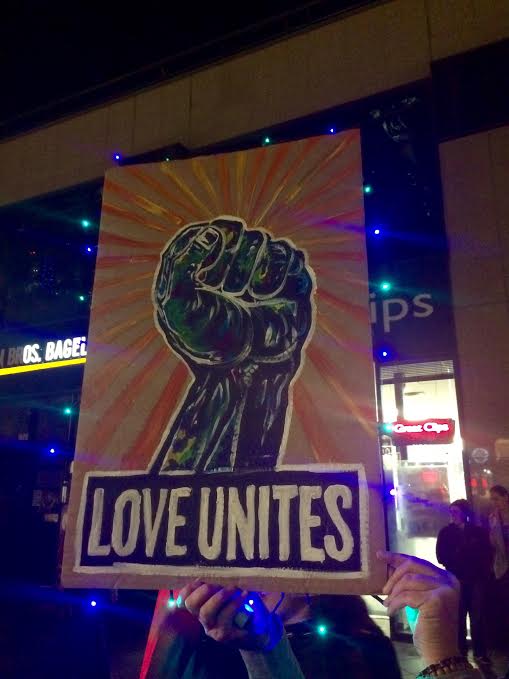
Many signs bore messages of unity and peace
Here is some audio I grabbed last night in downtown Denver as marchers protested President-Elect Donald Trump. While many highlighted the deep divisions are nation now faces, messages of unity and healing ran even deeper.
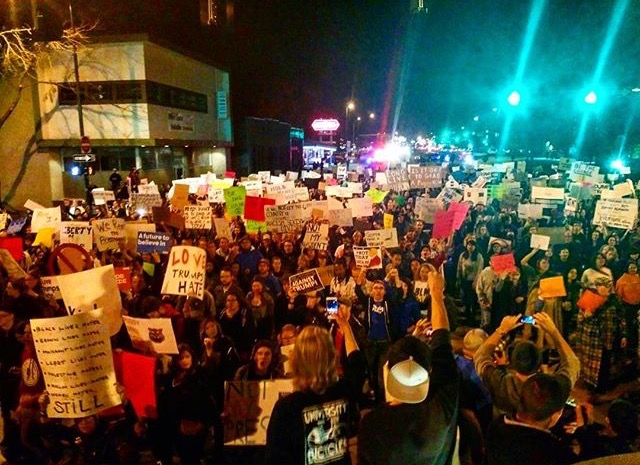
protestors gather in downtown Denver
Campaign Cost of ColoradoCare
Another hotly contested item on this week's Colorado ballot is Amendment 69, widely referred to as ColoradoCare. This amendment to the state constitution would implement a state-wide, single payer healthcare system based on funds derived from a 10% income tax. A 21-member board would govern the administration of ColoradoCare, who's members would vote for candidates to serve on the co-op's board and decide whether taxes should be increased to provide additional funding to the program.
Almost $5 million has been raised in contributions to the opposition and support committees, making this yet another expensive campaign on this Tuesday's ballot. See where these expenses are coming from, as well as other cost breakdowns of the campaign for Amendment 69.

The Battle Over Ballot Measure 2H
This Tuesday, Boulder will decide whether or not to pass a tax on sugary drinks after what has become the most costly campaign in Boulder history. The two opposing groups, No on 2H and Healthy Boulder Kids have cumulatively raised $1.22 million dollars in an attempt to sway voters. No on 2H has raised the most money from only two major donors, the American Beverage Association and The Coca-Cola Company, whereas Healthy Boulder Kids has received funds from 65 different individuals and organizations to fund their campaign. Thanks to the Boulder County Clerk's office, here's a sneak peak at how much money each campaign has raised, and where it's coming from.

From Tequila to Tech: Manuel Gonzalez's Quest to Unite Food and Finance

"Hold on a minute, I need to get my mojo ready"
Manuel Gonzalez steps behind a black curtain and fiddles with his microphone as he prepares to make his entrance on stage at FoodBytes! Boulder. As founder of the FoodBytes! event, he is clearly in his milieu, comfortable and confident. He tucks a stray wire behind the neatly pressed lapel of his blazer worn over a plain white shirt that hints at his air of Silicon Valley business-cool.
"You're up, Mr. Gonzalez." says an aid, ushering Gonzalez onto the stage.
"Mr. Gonzalez was my father. Call me Manuel."
Manuel Gonzalez Guzman was born in Guadalajara, Mexico, a large city in the Jalisco region famed for its mariachi culture and tequila.
"Tequila was really my first love," said Gonzalez. "Oh God, I love tequila."
Gonzalez's love of the liquor derived from the native blue agave plant blossomed while studying at the Universidad Panamericana, but not the typical reasons a college student might love tequila.
"I loved the craft of it, the growing it. It's beautiful,” says Gonzalez, “ I especially loved the business of it.”
His affinity for food and commerce lead him to earn a degree in business administration and finance. After graduation, Gonzalez worked in and around the agri-business sector for several years before founding his own business in 1987, according to his LinkedIn profile.
The Gonzalez Guzman Alimentos company was a dairy distributor specializing in sour cream and yogurt in Mexico. Though it wasn’t tequila, the small business was profitable.
"For my first business, it was pretty good," said Gonzalez.
In December of 1994, over-confidence in the newly agreed upon NAFTA and the Mexican presidential election collided, resulting in the collapse of the peso in what is commonly referred to as the 1994 Tequila Crisis. Poverty and unemployment skyrocketed as Mexico fell into recession, causing Gonzalez to sell his company and leave the country.
"In the end,” says Gonzalez, “it was probably a good thing."
In the wake of the financial collapse, Gonzalez enrolled in The McDonough School of Business at Georgetown University in the hopes of restarting his career in finance armed with an MBA and a more vigorous economy. After receiving his MBA, Gonzalez was hired by Rabobank, a Dutch investment firm specializing in food and agri-finance to serve as a project manager in agri-finance.
"Food has always been my passion," said Gonzalez. "I'm always connecting people in agriculture and business. It's my passion."
Rabobank was decidedly a good fit. Originally started as a farmers' bank in 1972, Rabobank has grown to become one of the 30 largest banks in the world in terms of Tier 1 capital, the principal measurement of a bank’s worth, though it focuses primarily on food and agribusiness subsidies and investment.
This passion for food and agriculture propelled him from project manager to eventually become the head of Rabobank Mexico in 2008. After four years in Rabobank's top leadership position in Mexico, Gonzalez was transferred to the U. S. to serve as Managing Director of the West Coast region for Rabobank.
Gonzalez's penchant for merging the sometimes disparate fields of agriculture and business prompted him to found FoodBytes! in 2015. FoodBytes! is a combination tech start-up conference pitch slam and networking event that fuses agriculture, business and tech in a Silicon Valley model of business.
"Working with Manuel is invigorating and inspiring because he is, in my opinion, a true visionary," said Sarah Kolell, head of communications for Gonzalez's Western Region Team. "He sees further down the road than most people do and he has the ability to help others not only see his vision but enthusiastically work toward making it a reality."
a business owner makes her case for investors at FoodBytes! Boulder
"It is important to me that I get farmers to think more like businessmen, and the businessmen to think more like farmers," said Gonzalez. "Then, maybe something exciting will happen".
FoodBytes! was first held in San Francisco, where Gonzalez is now based. It hosts events in Brooklyn and for the first time this year, in Boulder.
"People here are foodies," said Gonzalez, "there is a strong tech culture and entrepreneurial spirit. That's why we wanted to have FoodBytes! here."
Gonzalez seeks to disrupt the food chain by uniting his fondness for finance and food because, as he puts it, it's in his own interest as a food lover.
"I love salsa,” said Gonzalez. “Anyone who can grow a better tomato, and anyone who can make that into a better salsa, I need to know about that! That is important to me!"
At FoodBytes!, Boulder-based food and agriculture start-ups had their chance to pitch their business to Gonzalez, who served as a judge in the contest. Everything from vegan fitness frosting, beer-based protein and "Fitbit for cows" elicited plain delight on Gonzalez's face as he listened intently to the pitches.
investors vote for the crowd favorite during the business pitch contest in Boulder
"I'm really looking for someone who has that something special, that solution to a problem that no one else has, that ability to make a true connection with investors," said Gonzalez.
He is particularly interested in the problem of food waste, a challenge that has become a sort of pet project of his as he pursues innovation in the tech and agriculture sector.
"Waste is the number one issue right now," said Gonzalez. "That's where the innovation is happening, and it's really exciting. The ability to take waste, and make it into food, into profit, it's really incredible.”
In an effort to expedite progress and collaboration in the tech and agriculture industry, Gonzalez recently launched TERRA, a San Francisco-based food and agriculture technology accelerator that plans to partner leaders and novices across food, technology, and agriculture. According to TERRA's website, it is a first-of-its-kind opportunity to bring together agriculture and technology on one campus.
"This project is really important to me. We're always looking bring people together. That's my job, essentially. To make connections. To feed people, " said Gonzalez.
"He's creating relationships that lead to feeding people in a way that respects the ag producers and the earth, it is work that I’m proud to be part of, " said Kolell.
Gonzalez was reflective backstage at FoodBytes! After the contest.
"Look around. Look at what these people are doing. They're changing the way we feed people, they're changing the world." said Gonzalez.
"Here you go, Manuel," interjected an aid, handing Gonzalez a bowl of pungent, chunky salsa.
"Ah yes! My salsa!" said Gonzalez, scooping a heaping portion into his mouth with a tortilla chip.
"Now this is world changing."
Have Your Beer and Drink it Too - Lowering the Carbon Cost of Beer

Scott Osborn, an associate professor of biological engineering at the University of Arkansas is teaming up with Core Brewing Company to reduce the carbon footprint of beer. Northwest Arkansas-based Core brewing company, now Arkansas’ largest, was intrigued by Osborne’s carbonation technique which saves money by using carbon harness from the brewing process and yields better tasting better.
The amount of CO2 produced in the brewing process is several times larger than the volume of beer produced. When the yeast used in the brewing process consumes sugars and wort, an infusion of malt and grains used in the brewing process, it produces alcohol and and CO2. The more alcohol the yeast produces, the more CO2 it produces.
Picture a keg of beer. Then picture more kegs, and that’s about how much CO2 is produced in the process. In comparison to other high-emission activities such as the burning of fossil fuels it's not much, but, for those of us unwilling to curtail our love of craft brews, it’s something.
Osborn, in collaboration with University of Arkansas students has created a tank that has the ability to capture carbon produce in the brewing process, and re-infuse it into the beer much more efficiently. A small amount of beer is pumped from the the carbonation tank and sprayed into a pressure chamber full of carbon dioxide gas. The spray of beer absorbs the gas and forms a liquid layer on the bottom half of the pressurized chamber.
The pressure then pushes the carbonated beer out to of the chamber and back into its original carbonation tank. The pressurized carbon dioxide causes the beer to hold onto a higher concentration of dissolved CO2, higher than in the traditional brewing process. When the small batch of beer is injected back into the carbonation tank it mixes with the larger batch so that the highly carbonated beer infuses the tank with an extra burst of gaseous bubbles.
Osborn estimates that it will save roughly three times the volume of beer produced worth of carbon, and will cost 60 percent less than the traditional brewing process, which relies on additional carbon added to the beer, which can distort the taste and texture. Osborne’s process uses carbon captured from the fermentation process, which results in dramatically lower emissions, and, Osborne says, a better tasting beer.
“We wanted to have better control over the product, which will result in better quality” said Osborn.
Better beer? With a lower carbon footprint?
Pour me a pint, please.
A Threshold Sneak Peak at Clean Energy
The Threshold team, Amy Martin, Nick Mott and myself sat down with Chris Clack to discuss the future of our grid. Here's a video sneak peak of what's in the works for our podcast and the future of clean energy.
Video by Nick Mott & Zoë Rom